
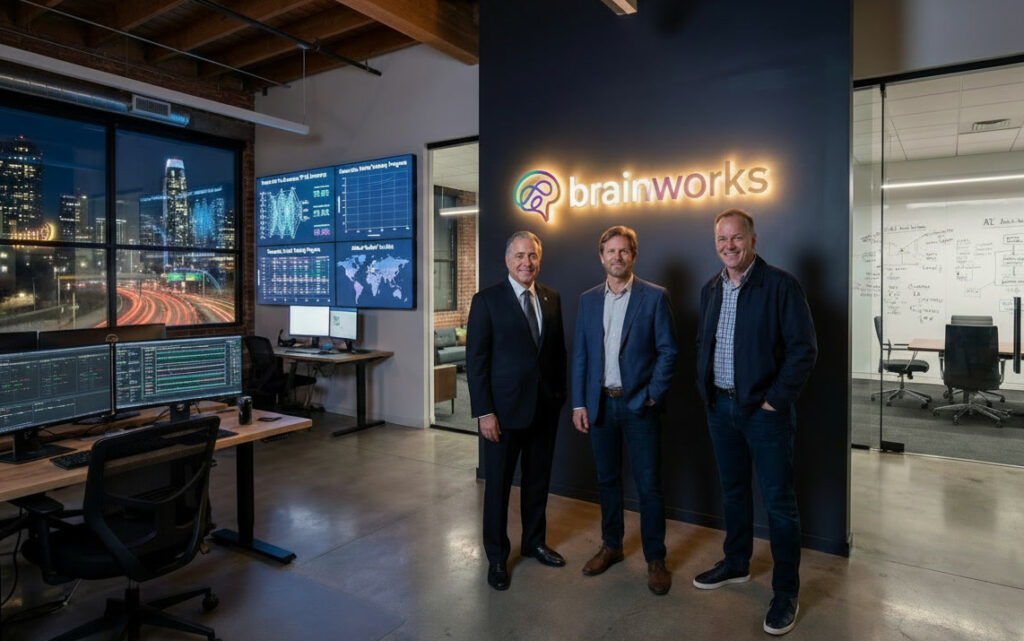
How We Built an AI-Native Fund
Or, How to Running a $50 Million Fund Like a $500 Million One
By Phillip Alvelda, Managing Partner, Brainworks Ventures
Watch the video: How We Built an AI-Native Fund (90 seconds)
We run a fifty million dollar fund that accomplishes what five hundred million dollar funds achieved just five years ago.
That’s not marketing. It’s a direct consequence of building Brainworks as an AI-native operation from day one.
Most venture funds today are AI-focused. They invest in AI companies. They talk about AI on panels. They’ve added AI to their investment thesis decks. But operationally, they’re still running the same infrastructure they built in 2015—or 2005. Armies of analysts screening deals. Manual portfolio monitoring. Quarterly reporting that requires weeks of preparation. Due diligence processes designed for an era when information was scarce and expensive.
We looked at that model and asked a simple question: if we’re investing in companies that use AI to achieve 10x operational leverage, shouldn’t our fund do the same?
The answer was obvious. The execution took more thought.
What AI-Native Actually Means
Let me be specific about what we mean by AI-native, because the term has been diluted by overuse.
AI-native doesn’t mean we use ChatGPT to write emails. It means we’ve rebuilt the core operations of venture capital from first principles, using AI as the foundation rather than an add-on.
Traditional VC funds need armies of analysts to screen deals. They receive thousands of inbound pitches per year. Someone has to read them, categorize them, identify the ones worth a partner’s time. At a large fund, that’s a team of five to ten people whose primary job is filtering noise from signal.
We’ve automated roughly ninety percent of that process. Our AI systems ingest pitch materials, extract key data points, compare them against our investment criteria, and surface the opportunities most likely to be relevant. The partners see a curated feed of high-potential deals, not an undifferentiated firehose. We spend our time evaluating investments, not sorting email.
The same principle applies across every operational function. Portfolio monitoring that used to require manual data collection from dozens of companies happens continuously. Market intelligence that used to take a research team weeks to compile arrives in real-time. LP reporting that used to be a quarterly fire drill updates automatically.
The result is that a three-partner fund can operate with the analytical firepower of a much larger organization—while deploying more capital to companies and less to overhead.
The Economics of AI-Native Operations
The traditional venture capital cost structure looks something like this: a fifty million dollar fund might have eight to ten people, including partners, associates, analysts, and operations staff. Salaries, benefits, office space, travel, and other overhead can consume two percent of committed capital per year in management fees—which sounds reasonable until you realize that’s a million dollars annually that doesn’t get invested in companies.
Over a ten-year fund life, that overhead compounds. A significant portion of LP capital goes to running the firm rather than backing founders.
Our model is fundamentally different. By automating the work that traditionally required large teams, we’ve reduced operating expenses by approximately ninety percent compared to conventional funds. That’s not a typo. Ninety percent.
What does that mean in practice? More of our LPs’ capital goes directly into portfolio companies. We can support forty to fifty investments instead of the twenty to twenty-five typical for a fund our size. Our fee structure reflects our actual costs, not the bloated infrastructure of legacy firms.
This isn’t about being cheap. It’s about being efficient. Every dollar we don’t spend on overhead is a dollar we can deploy to founders. Every hour we don’t spend on administrative tasks is an hour we can spend on what actually creates value: sourcing deals, supporting portfolio companies, and building relationships.
More Attention, Not Less
The obvious concern with a lean operation is whether portfolio companies suffer. If you don’t have a platform team providing recruiting support, marketing expertise, and operational guidance, are founders left to fend for themselves?
The reality is the opposite. Our founders get more attention, not less.
Here’s why: at a large fund with a hundred portfolio companies and a substantial platform team, support is diffuse. The recruiting specialist is spread across dozens of companies. The marketing advisor has limited bandwidth. When a founder needs help, they’re often routed to junior staff who lack the experience to provide strategic guidance.
At Brainworks, the partners do the work. When a founder needs strategic advice, they’re talking to someone who’s founded twelve companies, invested in hundreds more, and spent decades in AI. When they need help with a corporate partnership, they’re connecting with someone who’s been on the corporate side of those deals. When they need technical guidance on their AI architecture, they’re getting input from someone who trained at MIT’s AI Lab and directed programs at DARPA.
AI automation handles the routine operational work that used to consume partner time. Deal screening, portfolio monitoring, market research, reporting—all of that happens in the background. That frees us to focus on what actually moves the needle for founders: strategic guidance, network introductions, and the kind of pattern recognition that only comes from decades of experience.
The math is straightforward. A fifty million dollar fund with three partners and forty portfolio companies means each company gets meaningful partner attention. A five hundred million dollar fund with eight partners and a hundred portfolio companies means each company gets a fraction of that. Smaller fund, deeper engagement.
Practicing What We Preach
There’s a coherence argument here that matters.
We invest in AI-native companies—startups that use artificial intelligence to achieve operational leverage their competitors can’t match. Five-person teams that outperform fifty-person incumbents. Companies that accomplish in six million dollars what previous generations needed a hundred fifty million to achieve.
If we believe that thesis, we should live it. It would be strange to invest in AI-native companies while running our own fund like it’s 2010. The founders we back would notice the inconsistency. The LPs should notice it too.
More importantly, operating as an AI-native fund makes us better investors. We understand firsthand how AI transforms operations because we’ve done it ourselves. When a founder tells us they can run their company with a lean team because of AI leverage, we know what that looks like in practice. When they describe automated workflows that replace manual processes, we can evaluate those claims from experience.
The best investors in any sector are usually operators who’ve built in that space. The best AI investors should be the ones who understand AI deeply enough to use it themselves. That’s not theoretical for us—it’s how we run the firm.
What This Means for Due Diligence
Our AI-native operations have a direct impact on how we evaluate investments.
Traditional due diligence takes weeks or months. Partners meet with founders. Associates pull market data. Analysts build financial models. References are checked. Legal documents are reviewed. By the time a decision is made, the best deals have often moved on to faster-moving investors.
We’ve compressed that timeline dramatically. Our AI systems automate most of the preliminary analysis—market sizing, competitive landscape, comparable transactions, financial modeling. That work happens in days, not weeks. We can move from initial meeting to term sheet in a fraction of the time traditional funds require.
Speed matters in early-stage investing. The best founders have options. If you take six weeks to make a decision, you’ve already lost to the investor who moved in two. Our AI-native operations give us a structural advantage in winning competitive deals.
But speed doesn’t mean cutting corners. The analysis still happens—it just happens faster. We’re not skipping diligence; we’re compressing it by automating the parts that don’t require human judgment while focusing partner time on the parts that do. Technical evaluation of AI architectures. Assessment of founder quality. Strategic positioning and market timing. Those decisions still require experienced humans. Everything else can be accelerated.
The Multiplier Effect
When you add it all up, the AI-native model creates a multiplier effect across every dimension of fund performance.
Lower operating costs mean more capital deployed to companies. Faster due diligence means winning more competitive deals. Partner-level attention means better founder support. Automated monitoring means earlier detection of both problems and opportunities. Real-time market intelligence means sharper investment decisions.
Each advantage compounds on the others. A fund that can support more companies with more attention while spending less on overhead and moving faster than competitors has structural advantages that persist over the entire fund life.
This is why I say we run a fifty million dollar fund like a five hundred million dollar one. It’s not about pretending to be bigger than we are. It’s about using AI to amplify what a small, experienced team can accomplish.
Five years ago, this wouldn’t have been possible. The AI tools didn’t exist. The cost of building these systems would have exceeded the savings. Today, frontier AI models have crossed the threshold where this approach is not just viable but obviously superior.
The venture firms that recognize this shift will outperform. The ones that don’t will be adding turbochargers to horse-drawn carriages while AI-native funds drive Formula 1 cars.
We built the race car.
Interested in learning more about how Brainworks operates as an AI-native fund? Reach out at alvelda@brainworks.ai or visit brainworks.ai.